
Graphic Design for Business: The Essential Materials
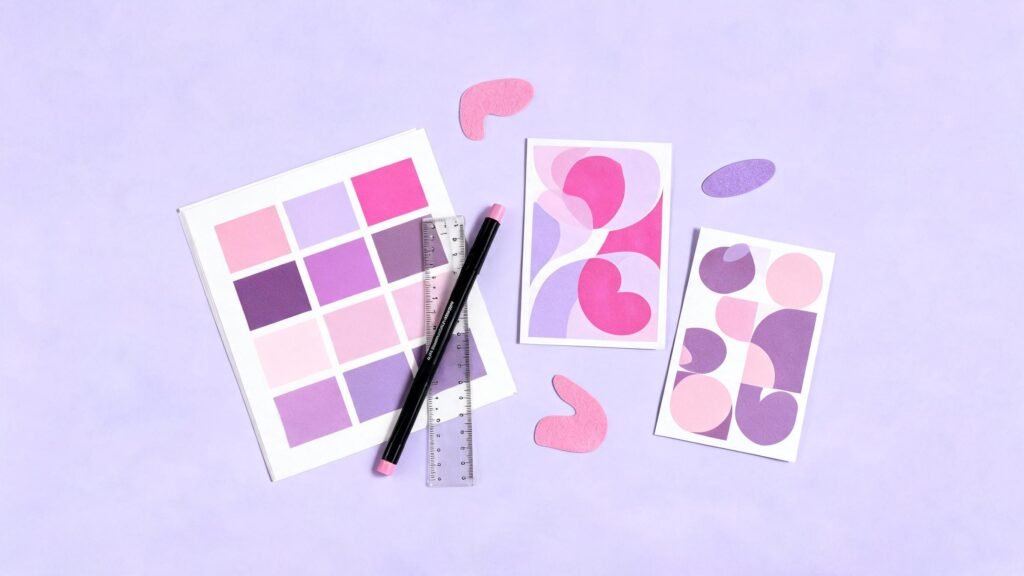
Whatever the field, every business communicates visually before it gets the chance to say a single word. Polished graphic design signals that you mean business, while improvised materials raise doubts. In this article I look at the graphic materials a business truly needs, why brand consistency matters and how to choose between print and digital.
What graphic design actually means for a business
Graphic design is not just a nice logo. It is the visual system that makes a brand recognisable: colours, fonts, shapes, spacing and the tone of the imagery. When all these elements work together, your customer recognises you instantly, whether they see an Instagram post, an invoice or a poster on the street.
In practice, a good graphic design project answers three questions: who you are, what you offer and why someone should trust you. Everything else, from the layout to the choice of a particular shade, is simply a way of answering those questions clearly.
The graphic materials every business needs
Not every business needs the same things, but there is a set of graphic materials that turns up almost every time. Let me go through them one by one.
Logo and visual identity
The logo is the starting point. From it flow the colour palette, the fonts and the overall style. A well-thought-out logo works just as well on a phone screen as it does on an illuminated sign. Ideally, you receive several versions: on a light background, on a dark background and a simplified version for small spaces.
Business cards
Although some consider them outdated, business cards remain a powerful tool at meetings, trade shows and events. What matters is not only the information but also the quality of the paper and the finishes. A well-made business card leaves a tactile impression that simply swapping phone numbers cannot match.
Flyers and leaflets
Flyers are useful for promotions, launches or service presentations. The secret to an effective flyer is hierarchy: a clear headline, an obvious benefit and a visible call to action. Too much crammed-in text undoes any design effort.
Banners
Whether we are talking about physical banners for a stand or digital banners for online campaigns, the rule is the same: a short message, good contrast and a single point of focus. A banner does not have the luxury of time a leaflet does; it has to be understood at a glance.
Social media visuals
Social networks consume visual content at a relentless pace. Hence the need for consistent templates for posts, stories and cover images. When all the visuals follow the same style, the feed becomes recognisable and professional, and your audience remembers the brand more easily.
If you want to start with a complete, consistent set, you can see what a package of graphic materials tailored to the real needs of a business involves.
Why brand consistency matters
This is where you see the difference between graphic design done at random and design built as a system. If the logo uses one shade of blue, the website another and the flyers a third, the customer’s brain perceives chaos. Visual consistency, on the other hand, creates a sense of stability and professionalism.
Consistency also has a practical effect: it saves time and money. With a clear set of rules, each new material is produced faster, without reinventing the style every time. On top of that, a consistent brand is remembered several times more easily than one that keeps changing its face.
To maintain that consistency, many businesses use a small brand guide: which colours to use, which fonts, how to position the logo and what tone the images should have. It does not need to be a dense document, but it does need to exist.
Print versus digital: how to choose correctly
A common mistake is to treat print and digital the same way. In reality, they follow different technical rules, and ignoring them ruins the final result.
The specifics of print
Printed materials are prepared in CMYK colour mode, at high resolution, usually 300 dpi, with a bleed added at the edges. Colours look slightly different on paper than on screen, so a printed proof before a large order is always a good idea. With print, mistakes are costly: once printed, a material can no longer be corrected.
The specifics of digital
In digital we work in RGB, with files optimised for fast loading and for various screen sizes. Here the flexibility is huge: you can adjust a visual at any time, test variations and measure the results. In return, it matters enormously that the materials look good on mobile too, not just on desktop.
The practical conclusion is that most businesses need both, designed from the start on the same visual system. That way, a graphic material can move from digital to print without losing its identity.
How to begin: a simple plan
If you are starting from scratch, the natural order is: first the logo and visual identity, then the basic materials such as business cards and social media templates, and later flyers, banners and anything else your activity calls for. Investing in consistent graphic materials is not a luxury but a foundation that supports your credibility over the long term.
Frequently asked questions
How long does it take to produce a complete set of graphic materials?
It depends on the complexity, but a basic package made up of a logo, visual identity and a few essential materials is usually produced in one to three weeks. That timeframe also includes the feedback and adjustment stages.
Do I need graphic design if I already have a logo?
Yes. The logo is only the starting point. For a consistent presence you also need colours, fonts and templates applied consistently across all materials, both in print and digital.
Can I use the same files for print and online?
Not directly. Print requires files in CMYK at high resolution, while digital needs files in RGB optimised for the web. The design can be the same, but the files are prepared separately for each medium.
What happens if I do not keep my visuals consistent?
The brand becomes hard to recognise and seems less trustworthy. Customers find it harder to remember a business that keeps changing its style, and each new material takes more time to produce.

Need a website or online promotion?
Tell me briefly what you need and you get a clear quote, no obligations.